

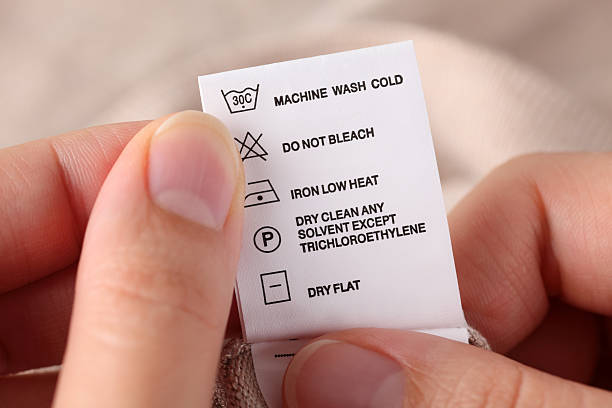
How many times have you been annoyed by labels after buying new clothes? Those little pieces of fabric sewn on the inside of the collar or on the side are details that we would like to remove as soon as possible. But the label hides a lot of essential information, with symbols that can tell you a whole story about the care of that clothing item. Each symbol has a specific purpose and we will explain more to you in what follows.
The first labels and symbols on labels
Clothing labels emerged with the Industrial Revolution, as mass production made mass-produced clothing widely available. Before that, clothes were made by local tailors, and care instructions were provided directly by the craftsman. But when factories began mass-producing, a standardized way of communicating these details became necessary, using symbols on clothing .
The first labels only had basic information: the type of material and perhaps the country of origin, but in the 1950s, with the growth of the textile industry and the diversification of synthetic fabrics, a common problem arose: how do you tell if a material is resistant to high temperatures, if it can be ironed, or if it should be dry cleaned? To answer these questions, graphic symbols were introduced, which were intended to be universal, so that they could be understood regardless of language.
The standardization of clothing care symbols began to take shape in Europe, and the first symbols were printed on labels in the 1960s, with the founding of the GINETEX organization, and since then, the symbols have become an international language, adapted and used throughout the world.
Clothes washing symbols
One of the most important sets of symbols are those for washing clothes, because how you treat your clothes in the washing machine can make the difference between keeping them for years or destroying them after just a few uses. Have you ever noticed the symbol of a small basin? This is the starting point and you will be able to correlate them with various washing machine signs.
Symbols in this category can include lines, dots, and other subtle additions. For example, a line under the sink signifies a delicate cycle, while dots indicate the maximum temperature allowed. It’s like a secret code that tells you exactly what the fabric can handle.
Some labels may also include special variations, such as a basin with a hand above it, which indicates hand washing. Also, if you see a large "X" over the basin, it's clear: the garment should not be washed in water at all, but taken to a dry cleaner. So, even though the symbols may seem tiny, they contain vital details about the fabric's resistance to water and abrasion.
Clothes drying symbols
Drying clothes is another important aspect, and the symbols on the labels come to your aid to prevent any mistakes. When you see a simple square, without other signs, this means that the garment can be dried naturally, without restrictions, but things get more complex if the square includes circles or lines.
A square with a circle inside represents tumble drying, and the dots on the circle indicate the recommended temperature. If there is an "X" over the symbol, it's clear that you should avoid the tumble dryer at all costs. Conversely, horizontal or vertical lines within the square suggest alternative drying methods, such as on a flat surface or on a hanger.
These symbols tell you more than you might think at first glance, as they give you indications on how to preserve the shape and texture of your clothes, especially in the case of delicate materials or fabrics that can get wet.
Ironing and dry cleaning symbols
Ironing clothes may seem like a simple task, but the symbols on the label can reveal important details about the appropriate temperature and methods. The iron drawn on the labels is quite easy to recognize, and the dots placed inside it indicate the maximum heat level it can withstand.
A single dot signifies a low temperature, suitable for delicate fabrics like silk or polyester. Two dots indicate a medium temperature, ideal for cotton or linen, while three dots give you the green light for high temperatures, perfect for ironing thicker clothes. If the iron has an "X" over it, it's clear that the fabric shouldn't be ironed at all.
Dry cleaning is another category where symbols become essential: if you see a simple circle, that means the garment can be taken to the dry cleaners. Letters placed inside the circle, such as "P" or "F", provide additional guidance for cleaning professionals.
So, the symbols on clothing labels are more than just drawings: they are an international language that gives you clues on how to treat materials to keep them in the best possible condition.

Leave a comment
All comments are moderated before being published.
This site is protected by hCaptcha and the hCaptcha Privacy Policy and Terms of Service apply.